
With the release of Nikon D5000 DSLR camera, market is buzzing with it's new features and comparison to other cameras in the market. I meet increasing number of people everyday getting into photography and the release of this new camera, Nikon D5000, is targeting those customers who are fresh and want to get into photography or upgrade themselves from point and shoot cameras. I started with Nikon D60 and later upgraded to D90. When I bought my first camera, I also did lots of comparison between different brands and the models of same brand. It is always confusing task to compare when you are not sure what exactly you are looking for on your first camera. But if you already know the specification you are looking for, your task is half completed and the next question would be comparison between the price of two. Since the release of Nikon D5000, it has been compared to the models of different brand or even within Nikon lineup. Since, I haven’t used other brand DSLR yet, I am trying to compare it with my own D90 and see how it differs to each other from different perspective.
People started comparing these two products because it has similar features. Due to rapid technological innovation, D5000 seems to have even more features than D90 and the price is much lower. But when you look more closely about the features avaialble in Nikon D90 and it's flexibility over the situation, there is no doubt that D90 is the best camera for the price you pay. But let’s discuss some of the key differences I found out during my research about these two cameras.
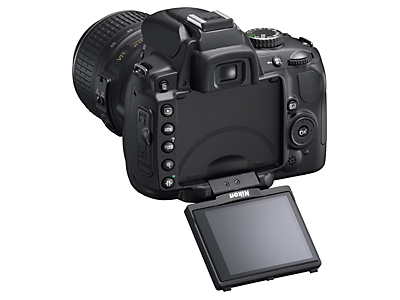
Nikon D5000
As I mentioned earlier, Nikon D60 was my first DSLR camera which I bought almost 18 months ago. And D5000 is considered as a replacement for D60 with some add-in features. D5000 offers more features than D60 like vari-angle color LCD monitor, 12.3 MP picture quality, records 720p HD movie with sound, 19 Auto-exposure Scene Modes, Live view, GPS Geo-tagging, 15.8 x 23.6mm size CMOS sensor like in D90 and many more. D90 lacks some of the features of D5000 like 19 Auto-exposure modes, vari-angle color LCD etc.
The main features that D5000 lacks over D90 are wide range of lens compatibility, off-camera flash control, dedicated buttons that allow immediate access to the settings. Nikon D90 has a built-in AF motor which gives the capability to support wide range of lens available in the market. This is one of the most important feature to be considered that D5000 doesn't have. When the camera has a built-in focus motor in it, it can utilize the AF lens for autofocus that doesn't have a motor inside the lens itself. Since D5000 doesn't have a AF motor inside the body, if you use AF lens with it, you have to manually focus. Next thing I noticed is Nikon D90 has a commander mode which allows you to control off-camera flash using the built-in camera flash. When you setup a commander mode in D90, you can actually use the built-in camera flash to send a signal over the air and control off-camera flash. This is pretty impressive feature and lot of time specially when we do indoor shooting, we use this feature for proper light setting. D90 has dedicated buttons for frequently used settings like ISO, preview of DoF, White Balance etc. Instead of navigating through menu setup, you can use those dedicated buttons to change your settings which is very handy and useful when you are in a hurry to capture the shot.
D90 has many other features that most of the people may not use in daily shooting but it is worth to have it there in-case if you need it. But that doesn't mean D5000 is a bad camera at all. Actually, Nikon D5000 comes with more features in affordable price. When it is time for you to decide which camera should you be buying, you have to answer few question to yourself; what do you want from your new camera and what is your budget? If you own point and shoot camera and want to upgrade, D5000 might be the perfect choice at this moment but if you already own one of the DSLR body like D40 or D60 for example and want more features, then probably getting Nikon D90 will be the best option.


I primarily shoot landscape and cityscape which requires me to take a long exposure and bracketed shots. Even though there is no hard-and-fast rule, there are few generally accepted practices among the photography communities for the camera controls and the settings, camera and the lens types and the list of accessories one should have to get better results. Usually, combining a full frame (FX-Format) camera with the wide angle lens gives you the best possible frame for the landscape or the cityscape shots. If you shoot with a higher resolution DSLR, you can crop the images, change the composition during the post-processing and still have enough pixels left in them to print in a larger size. If you are more interested in shooting buildings and architectures, you would get better results by using the tilt-shift lens which allows you to move (tilt and shift) the part of the lens in relation to the image sensor in a wide range of directions and gives you the better and more natural perspective of the structure.
Since I stepped into the photography world in 2009, Nikon D810 is my fourth DSLR but second full frame camera after D700. The decision to upgrade D700 to D810 was influenced by the need for a moderately higher resolution camera which was designed and marketed for landscape photography. Over the last 10 years, I have tried and shot in different camera settings and lighting environments. I have traveled to many places to get a good shot and also made countless mistakes repeatedly. I have learned the most from my own mistakes which gave me some invaluable lessons about what to do and what not to do during the shooting process. All these years of mistakes and countless teaching moments gave me my own set of camera controls and the settings to follow. Today, I want to share that information with you and get your feedback if you have any.