Few Things To Consider When Taking Animal Shots

When I bought my first DSLR three years ago, I had no clue about the composition, photography technique, lighting and many other things. I just bought a DSLR camera because I had interest in photography and enjoyed taking pictures. I still remember a shot of a deer that I took from the back and was very happy with the result. It had shallow depth of field, well focused and good light. I couldn't find anything wrong with my picture and thought to share with my photography community. Guess what? My composition was completely wrong which I realized after fellow photographers commented about it. And you probably have already guessed what went wrong on my picture. Yes, I took the shot from the back of an animal and viewers couldn't connect to that photograph very well. I started learning from my mistakes and today, I thought I would write something about what I learned so far so that you don't have to go through same mistakes and waste your time. But instead, you can use that time for taking creative shots.

When shooting animals, there are few important camera settings and the composition ideas which you may want to follow to get better results and connect well to the viewers. Let me explain them briefly in points.

1. When shooting birds or animals, you may want to use the spot metering so that the camera meters exposure based on the focus point.

2. Use Continuous-servo (AF-C) Autofocus mode with the single point AF or the Dynamic Area AF Autofocus point. When you in AF-C mode, after you press the shutter release button, camera focuses your subject wherever you select the focus point and continues to monitor the subject to refocus if the subject moves along and the single point focusing method helps you to focus on particular area, an eye for example. Using the Dynamic Area AF helps you to track the moving subject if it goes out of focus in the frame. If you are shooting flying birds or fast moving animals, you may want to use the Dynamic AF points.

3. Use the widest aperture (smallest f number) possible so that you will get the faster shutter speed to freeze the motion of moving subjects.

4. While shooting animals, try to focus on eye as much as possible because it naturally draws the viewer’s attention to the photograph immediately.

Here are few photographs I took recently and hope you will like it.

UME_0078.jpg

This shot was taken at the National Zoo, Washington DC and I liked how this cat is cautiously look at me while drinking water.

DSC_0678.jpg

Learning from the mistake is the best way to learn. You will never forget what you learned and sharing those ideas with others help you grow even bigger and faster.

Understanding An MTF Chart For Lenses

If you own DSLR or planning to buy one in near future, you will be looking for lenses sooner or later and when time comes, you have to be very careful while choosing lenses. There are limited types of camera bodies (which are upgraded pretty frequently) but there are wide varieties of lenses and stay longer in the market before it gets upgraded to newer version. Usually camera bodies get upgraded in couple years whereas lenses get upgraded in 5 to 6 years or even more in some cases. Having said that, investment on lenses is long term than bodies and hence you have to be more careful when choosing correct lenses. Choosing lens depends on what kind of work you do in photography. If you are doing sports photography, you may want to choose fast telephoto lenses; for macro photography, you need macro lens; for landscape photography, you may want to choose wide angle lenses and for portrait, you need medium range prime lenses. Now you may be wondering which particular lens to choose among so many varieties and how do we know which lens is good over the other. It is very important to know that you have to compare lenses within its own category. That means you have to compare wide angle lens from one brand to wide angle lens of another brand because every lens is made with different components and materials to serve different purpose. OK then, do we have a tool to compare lenses? And the short answer is yes, we do. There is something called an MTF chart which gives us graphical model of the lens performance and describes behavior of particular lens in different conditions. You may find this article bit technical but I will try to explain as simple as I can.

What is an MTF Chart?

MTF is an abbreviation for Modulation Transfer Function and is widely used standard measurement to evaluate the performance of the lens. In a generic language, Modulation means the process of modifying signal to result an output from given input. In ideal case, lens should transmit all the lights it receives as an input but no lens is ideal and can't transmit all the lights because glass is not 100% transparent. So with the help of an MTF chart, we see graphical representation of how much light one lens can modulate (transmit) to the sensor in different scenarios.

The quality of lens depends on its resolution and contrast which are closely related to each other. If the lens can transmit high contrast, it can have better resolution power. But lens resolution is also dependent to other factors and that is why an MTF charts are preferred method to study optical performance but not the only one measure to determine its quality. An MTF chart consists two axis; X-axis and Y-axis.

The X-axis (horizontal axis) shows the distance from the center of the image (based on film or 35mm equivalent censor) toward the edges. In the graph, "0" represents the center of the lens and the different numbers represent the distance from center towards the edge of the lens in mm (millimeter).

The Y-axis (vertical axis) represents what percentage of light the particular lens can transmit. It is represented in percentage with maximum value of 1 meaning 100% transmittance of light (which is ideal case only). So in real case scenario, higher the Y-axis value better the lens performance will be (lens having 0.9 Y-axis value is better than lens having 0.7).

How to read an MTF Chart?

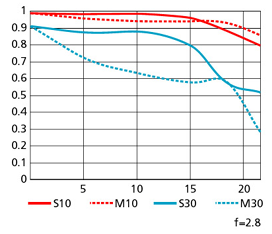
Below is an example of an MTF chart.  It has two pairs of lines (two solid and two dotted) plotted in different number values. Those different lines and numbers indicate how well the lens performs with different measurements.  When measuring the lenses performance for an MTF chart, the test is carried out with the lens working at its maximum aperture value.  An MTF chart consists of measurement for the Sagittal (Solid line) and Meridional (Dotted line) lines at both 10 lines per millimeter and 30 lines per millimeter hence producing a chart with 4 separate lines. In this case, you can think of 10 lines or 30 lines sketched inside 1 mm size area and we are going to see how well any lens can transmit the contrast between each lines so that quality of image can be produced in the sensor; better the contrast, better picture quality will be.

MTF Chart for AF-S NIKKOR 14-24mm f/2.8G ED lens

Wide (14mm)                                                                         Tele (24mm)

MTF Chart Wide Nikkor 14-24mm

MTF Chart Wide Nikkor 14-24mm

MTF Chart Tele Nikkor 14-24mm

MTF Chart Tele Nikkor 14-24mm

MTF chart for AF-S DX NIKKOR 35mm f/1.8G lens

MTF Chart NIKKOR 35mm

MTF Chart NIKKOR 35mm

Here are the few key things you have to know to understand an MTF chart. The red line (10 lines per millimeter) indicates the lenses ability to reproduce low spatial frequency or low resolution.  This line indicates the lenses contrast values and the higher and straighter this line is the better.  The higher the line appears the greater the amount of contrast the lens can reproduce. Similarly, the blue line (30 lines per millimeter) indicates the lenses ability to reproduce higher spatial frequency or higher resolution. This line relates to the resolving power of the lens and again the higher the line the better.

As the line starts on the left of the chart this represents the center of the lens and as the line moves to the right it indicates the edge of the lens.  So you can see how much the contrast and sharpness of the lens decreases from the center to the edge of the image.

Using an MTF chart to determine the Bokeh effect of the lens

Another factor that can be read from the MTF graph is the 'bokeh'. Bokeh is a term used to describe the quality of the out of focus areas a lens produces. The bokeh effect varies between lenses and the effect is influenced by the quality of the lens elements used and also the number of aperture blades in the lens design (more blades produce a better circle and therefore a better 'bokeh' effect). The closer the solid line and the dotted line are together, the better the 'out of focus' effect will be on a particular lens.

Nowadays all the major lens manufacturers include MTF Chart along with their lens specification.

Reference: Nikon Europe and Nikon USA

Varying Your Composition

This post is written by Guest Contributor, Janet Ochs Lowenbach. If you are also interested in writing a guest blog, please reach out using the form in the Contact page.

On a crisp, abnormally warm winter day, I decided to photograph a local amusement park that had been closed and made into an art center. Assignments like this are challenging because you have to try to do something different from everybody else. You have to go underneath the obvious scene (and its parts) and think about the meaning of what you see.  For example, does the building look abandoned and sad? Does it make you feel lonely?  Does a sign naming the park remind you of happy times? Does the carousel connote the laughter of children? By approaching the scene with an understanding of what it means to you, you can change the way you portray the park and it elements.

Glen-Echo-park-entrance.jpg

There are other ways that you can make your pictures alive. Look for shapes and lines, the quality of light, for repeating patterns, shots from far and near (or wide angle and telephoto),  parts of things that give the whole meaning, reflections – remember you can photograph anything you see-light and dark, textures.

Glen-echo-pattern.jpg
Glen-Echo-closeup.jpg
Glen-Echo-Park-2.jpg

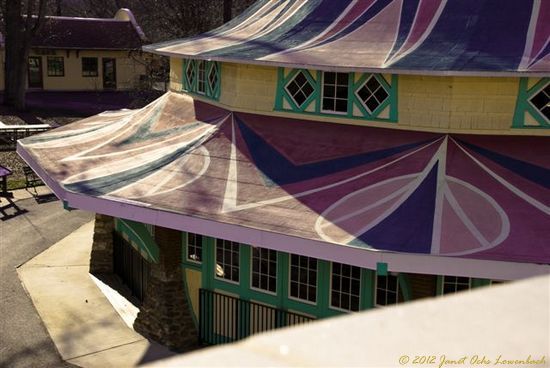
Sometimes people take 10, 20, or 30 pictures the same way over and over again. They stand with the camera at eye level, not moving, and go blam, blam, blam.  To change this boring approach, you must move into different positions when you take the picture. The result will be a new way of viewing the subject that you hadn’t thought about before. Eventually you will learn from your movements and be able to predict how you will change the impact of the photo. Repeat after me: up, down, over, under, past, by (past and by mean alongside an object like a wall). These changes add depth and impact to your photos. Note the grass shot from under the pattern of the mirrors on the white building which was top shot past, and the carousel pieces shot down and far and near. Note also that shooting up gives importance to the subject while shooting down diminishes it.

Glen-Echo-grass.jpg

Next time I will shoot more up and down and also demonstrate the impact of Lightroom which I used to edit these pictures.