Sunset Photography Tips

This post is written by Guest Contributor, Janet Ochs Lowenbach. If you are also interested in writing a guest blog, please reach out using the form in the Contact page.

The setting sun is one of the glories of the day and possibly the best memory of a vacation. But it takes some skill to produce photos that stand out from the crowd. First off, decide what you will include in your shot. Go to the site an hour ahead (you might want to look up the time of sunset earlier in the day), and walk around. See what scenes you might want to include and what objects you might want to place in the foreground of the shot for interest. (Silhouettes in the foreground are a valuable compositional device.) Plan to bring a tripod.

You might even go over the possible exposures in your mind. (It is best to use the smallest possible aperture is to increase depth of field.) Even though the sun is going down, it is important not to look directly at it when it is too bright. A rule of thumb I use is to hold my fist up to the horizon; I can shoot when the sun is below that. Frankly I have also looked directly at the sun when it is higher, but I am here to tell you I have read enough to know that is a very dangerous thing for your eyes and the camera itself. IT ISN'T WORTH IT! It is particularly important to never look directly at the sun through a long lens, which magnifies the light.

Begin taking the shots a half hour or so ahead of the event– the clouds take on wonderful colors before and after sunset. There is something exciting too about photographing the sun continuously as it dips below the horizon.

Sunset at Bailey Island

Sunset at Bailey Island

Plan to shoot at a variety of focal lengths –sometimes a wide panorama is best; sometimes you will want to narrow the field.

Sometimes the lack of contrast makes it hard to focus when the camera is on automatic; sometimes the shot won’t work at all and sometimes the camera misfocuses, but you won’t notice the fuzz until later. So make sure you take a fair number of shots on manual focus!

Remember the rule of thirds, and keep the major elements of your shots off center.

Make sure you experiment. You may choose aperture priority to make sure you have adequate depth of field. I like to experiment by shooting on manual (bracketing), once I have chosen the basic exposure from program priority.  Manual shooting makes you familiar with the exposures that work in various settings. I like to see the effects of more or less exposure (or even flash in the foreground) on the clouds as they are lit up by the dying of the light.

Here are some other sunset shots I took this summer in Bailey Island, a beautifully isolated spot on Casco Bay, an hour from Portland.

Sunset-3.jpg
Sunset-2.jpg

I suggest you to go out and try yourself. You might make a few mistakes but that is how you learn and grow. Best of luck!
Nikon Introduces Two New Mirror-less Cameras

This post is written by Guest Contributor, Janet Ochs Lowenbach. If you are also interested in writing a guest blog, please reach out using the form in the Contact page.

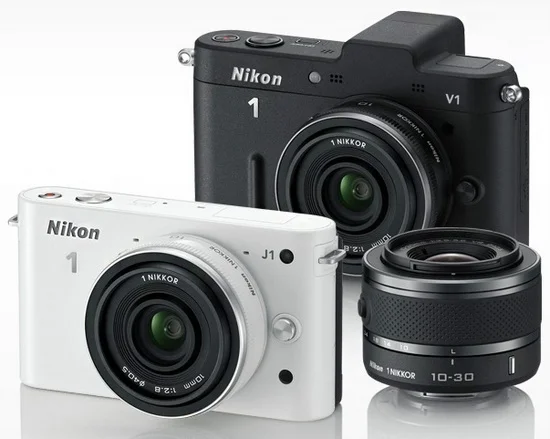
The cameras are totally new types of cameras and the imaging systems to go with them. Called the Nikon 1 series, the systems are designed to compete with the Olympus PEN and Sony NEX series models. They can be ordered, among other places, from the website of B&H photography, Amazon and other online stores. Nikon’s new 1 series cameras, the Nikon J1 and Nikon V1, are compact, mirrorless cameras that feature a new 10MP CX format (13.2 x 8.8mm / 3872 x 2592-dot), CMOS imaging sensor and a dedicated Nikon System 1 lens mount designed specifically for use with the new CX-format sensor.

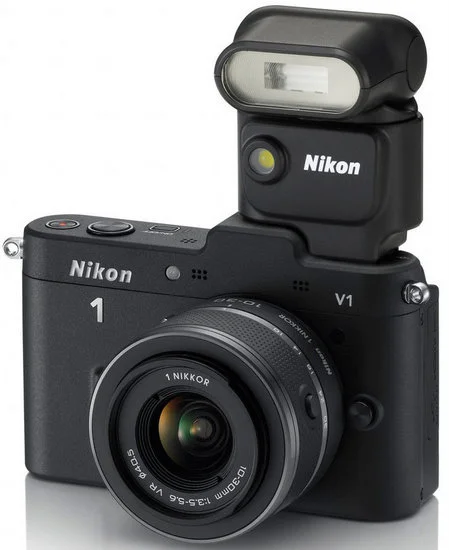
Nikon V1 with Flash

Nikon V1 with Flash

The top-of-the-line 1 series Nikon is the Nikon V1, which features a svelte form factor (4.4 x 3 x 1.7" / 113 x 76 x 43.5 mm), light weight (10.4 oz / 294 g camera body only) and a choice of viewing options—a high definition, 1,4400,000-dot electronic viewfinder (EVF) that comes into play when you raise the camera to your eye, or a more traditional 3.0-inch, 920,000-dot rear-mounted LCD for those who prefer squinting at a small screen under bright, sunny skies.  It costs around $850.

Other characteristics: up to 10 frames per second (full-res), JPEG, NEF (RAW) or NEF (RAW)+JPEG stills, full HD video (1,920 x 1,080/60i, 1,920 x 1,080/30p, 1,280 x 720/60p, as well as the ability to shoot at up to 60 frames per second for slow motion playback at 24 frames per second. There’s also a Smart Photo Selector that automatically captures a high-res still while recording HD 1080p video. The new System 1 cameras also feature Nikon’s newest dual core EXPEED 3 image processor, which according to Nikon is tuned to enable the new cameras to perform as advertised, including still capture at speeds up to 60 full-res frames per second—when you simply cannot afford to miss the shot.

Nikon V1 and J1

Nikon V1 and J1

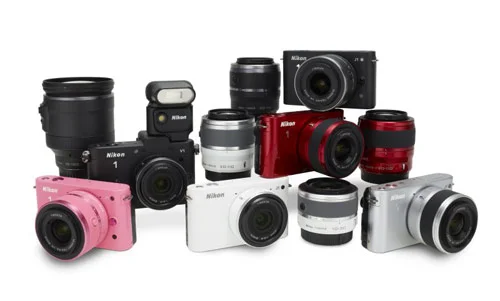
The Nikon J1 is slightly smaller, slightly lighter, and about $250 less expensive than the Nikon V1, and relies solely on a 3.0-inch (460,000-dot) LCD for composing and reviewing stills and video. But aside from the lack of an EVF, and a lower-res LCD, the Nikon J1 and V1 share all of the above mentioned attributes and performance specs. The Nikon J1 will be available in black, red, silver, white, and pink.

The ISO sensitivity range of Nikon’s System 1 cameras goes from 100 to 3200, with an extended ISO 6400 in the dark. Autofocus is also reportedly quite responsive, thanks to a new 73-point  hybrid AF system that automatically switches between phase and contrast detection as needed, and allows for full-time continuous focusing while shooting.

New Lens Mount

This new Nikon 1 lens mount, introduced on the innovative Nikon 1, V1 and J1 cameras is needed because the new cameras (being a mirrorless format) lack the bulk of the Digital SLR mirror arrangement, and so are much smaller than a full DSLR. There is also an adapter to allow the older Nikon full frame FX and also the smaller format DX lenses to be used with the new mirrorless cameras

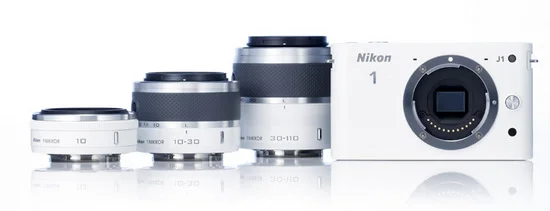
Nikon J1 and Nikon new lenses

Nikon J1 and Nikon new lenses

Here are the characteristics of the Nikon J1 Mirrorless Digital Camera:

  • A 10-30 mm / 30-110 mm Lens (White)

  • CX-Format High-Speed AF CMOS Sensor

  • EXPEED 3 Dual Image Processor

  • Interchangeable 1 NIKKOR Lens System

  • 10 fps Continuous Shooting in AF Mode

  • 73 Point AF Array

  • 3.0" 460K-Dot Anti-Glare Color LCD

  • Full HD (1080p) Movie Record Mode

  • Motion Snapshot 1-Touch Photo Animation

  • Smart Photo Selector

  • 10-30 mm VR Lens/ 30-110 mm Lens

Nikon 1 Series equipments

Nikon 1 Series equipments

Accessories for Nikon’s System 1 cameras include an SB-N5 Speedlight, an external stereo microphone for greater audio fidelity, and the GP-N100 GPS module, each of which couple to the camera via a Multi-Accessory port located on the camera’s top deck.

To complement the new cameras, Nikon has also introduced the first 1 Nikkor lenses, starting with the 1 Nikkor VR 10–30mm/f3.5–5.6 (27–81mm equivalent), which will serve as the standard kit lens for both cameras. There will also be a 1 Nikkor 10mm f/2.8 pancake lens (27mm equivalent), a 1 Nikkor 30–110mm f/3.8–5.6 (81–297mm equivalent) and a 1 Nikkor VR 10–100mm/4.5–5.6 (27–270mm equivalent) power zoom, which is optimized for smooth, quiet video capture.

Here are some advantages and disadvantages of the new mirror less camera and the CX lens.

Advantages of the Mirrorless Format

  • Small physical, pocket-size for easy storage.

  • Small weight, easy to carry.

  • Silent operation due to lack of mirror noise, so can be used in stage shows and other events when allowed.

  • Can use DX and FX lenses if you have any of these lenses with an adaptor, the camera has a lens multiplication factor of 2.7, thus a 70-200mm lens becomes an effective 190-540mm lens. A 500mm lens becomes an effective 1350mm.

  • This camera will be a great compact movie camera for High Definition movies.

  • Greatly improved image quality from the existing range of smaller sensor Coolpix cameras.

Disadvantages of the Mirrorless Format

  • No optical viewfinder, but there is an electronic viewfinder.

  • Focusing with any action shots may not be as precise and fast as the Digital SLR range of cameras

  • Higher pixel density with smaller pixels and probably more image noise as a result.

Composition Tips - Varying Your Scenic Shots

This post is written by Guest Contributor, Janet Ochs Lowenbach. If you are also interested in writing a guest blog, please reach out using the form in the Contact page.

If you want to take strong outdoor photos, consider these very basic principles. Anything you see, you can photograph. If you see a reflection of trees in a pond or sun on the water, a pink sky, even a rainbow, the camera can capture it. But you have to play around to get a good shot. Do you focus on the trees that make the reflection? Or on the surface of the water? Do you meter for the trees or the river? The answer is to experiment. With the digital camera you have endless numbers of pictures available for free, and you have a screen to evaluate your attempts. So test out your composition, metering, and focusing.

Also make sure you vary your camera angles. Don’t just shoot straight on. Lie on the ground, and shoot up. Stand up and shoot down. Shoot past a wall. Shoot over a foreground object. Shoot under an object (a branch) shoot though something that leaves a hole in the middle - (this is called a frame within a frame). These approaches will differentiate your work from that of others. They will add depth and drama to your photos.

There is a formula I use to make sure I remember to vary my shots: up, down, over, under, past, and through. Also shoot wide and far away, then shoot close to gain a microcosm of your world.

The picture below captures the beauty of the reflections, and the building is off to the left, consistent with the rule of thirds.

Beach-and-canal-oct-2006-136.jpg

What is the Rule of Thirds? Place the subject one third up, down, or sideways from the edge of the picture - rather than in the center of the shot. To understand the concept, draw an imaginary tic-tac-toe board over your viewfinder. Place the subject either on one of the lines or at the intersections of the lines. Don’t center it.

Compare this photo with the first picture. It lacks the movement of the vegetation on the water, and the subject is in the middle, rather than in one of the third spaces, making the picture staid and motionless.

Beach-and-canal-oct-2006-137.jpg

Include objects in your photos, person, a car, and animal to add drama, depth, and perspective.

In the next picture, the reflection becomes dominant and the figures to the right add scale.

Beach-and-canal-oct-2006-120.jpg

Lines, patterns, and shapes are the tools of the photographer.  This picture is more dramatic than the others because of the drama of the trees whose lines pull the eye of the viewer into and through the picture. In fact, the vegetation to the bottom and the tree on the right and left almost surround the water.

Beach-and-canal-oct-2006-038.jpg

Try to be different. Remember, don’t shoot straight on.  Shoot up, down, over, under, by and through. This next picture is strong; it is a very different way of viewing the waterscape.  With its leafy foreground, it adds depth and drama to the scene. It also tells a story; the red leaves say that fall is coming.

Beach-and-canal-oct-2006-108.jpg

For me, photography was always about the story and the message hidden in the picture and that is what I try to look into the photograph.

Happy Shooting!