Introduction To Different Exposure Modes - Which Exposure Mode Should You Use?

Today's most of the consumer level DSLRs have dedicated scene modes like close-up, portrait, sports etc which sets exposure automatically when you dial into the mode. Besides these pre-programmed modes, it also comes with few other exposure modes (A, S, P and M) to allow you control over camera’s default settings. When you dial into those pre-configured mode, portrait mode for example, you really do not have a control over exposure. If you want to manually set the exposure, you have to use one of the four modes (Aperture Priority, Shutter Priority, Program Mode and Manual Exposure) available in your camera.

Image Source : Wikipedia

Image Source : Wikipedia

Out of these four modes, three of them are semi-automated modes and one is fully manual mode. When you want to change from one mode into another, you would have to rotate the Mode Dial and select the mode you want to change into. These settings are not specific to any particular camera model but different companies may use different alphabets to denote these modes. For example, Nikon’s shutter priority mode is denoted by letter S whereas Canon’s is T but the idea behind it’s functionality is the same. But in this blog, I will be taking Nikon DSLR as a reference camera when I explain these different modes. Now, let’s get into our first exposure mode which is an Aperture Priority (A) exposure mode.

1. Aperture Priority

In an Aperture Priority (A) mode, you set the lens’ aperture value or give priority to the aperture value and your camera sets the shutter speed to control the overall exposure of the image. This mode is probably best when you want to control the opening or the closing of your lens to gain shallow or deep depth of field. You would have to use the smaller F-stop (f/stop) value to get the shallower depth of field (famous for portrait or close up shots) and you might want to use the larger f/stop value to get everything in focus (widely used in landscape photography).

This mode is best if you want to lock the aperture at fixed value and want your camera to set the shutter speed according to the aperture value you set. If your current aperture value and the shutter speed doesn't match to give you optimal exposure for the subject, you will get Lo or HI indicator in the camera viewfinder telling you that subject is too dark or too bright resulting into underexposed or overexposed photograph. If you get the indicator on, you might want to consider adjusting your settings.

2. Shutter Priority

Our second exposure mode is the Shutter Priority (S) mode which is just an opposite of the Aperture Priority mode. In this mode, you set the shutter speed and your camera will adjust the aperture value for the corresponding shutter speed to give you the balanced exposure. You might want to use this mode when you want to shoot fast moving subjects to freeze the motion (shooting sports events for example). This mode is also famous for landscape photography specially if your frame contains moving subjects like water falls or vehicles where you can control the speed of shutter to produce long exposure effects.

3. Program Mode

Third exposure mode is the Program Mode (P) which is almost like an Auto mode but it will let you override some of the settings on the camera. Nikon uses sophisticated algorithm to determine the best exposure by using the combination of aperture and shutter speed. The algorithm takes the present lighting conditions and other variables into account and program the camera setting to the best of it’s ability. When you frame your photograph and the correct exposure can't be achieved using pre-set value, Lo or Hi indicator in the camera viewfinder warns you about the underexposed or overexposed image. If you get the warning, you can adjust ISO setting to change the light sensitivity and see if that makes any difference.

Unlike Auto mode, Program mode allows you to change the camera parameters such as Exposure Compensation, Metering, ISO, White Balance etc. If you want to change the shutter speed and the aperture value, use the main command dial (also called rear command dial) and it will give you the different combinations of aperture value and shutter speed with the same exposure. When you do that, the letter P (for the Program Mode) changes into (P*) into LCD screen which Nikon calls the "Flexible Program". If you want to go back to the default settings of P mode, you just have to rotate the command dial to the left or the right until P* changes into P.

4. Manual Exposure

Our fourth and final exposure type is Manual Exposure (M) mode. If you want the complete control of your camera, Manual Exposure mode is what you need to dial into. Most of the experience photographers and the professionals use this mode very often because they know how their camera metering system is going to react under certain shooting environment. In the Manual Exposure mode, you can set the shutter speed and the aperture value in whichever combination you like. When you are in Manual mode, rotate the main command dial to change the shutter speed and the sub-command dial (also called front command dial) to change the aperture value. In this mode, you can set everything manually including ISO, White Balance, File Type etc.

Personally, my favorite for the landscape or the cityscape photography is an Aperture Priority (A) mode where I can set the lens aperture to certain value and let the camera decide the shutter speed. If the lighting situation is tricky, I use the Manual mode and control both the Aperture value and the Shutter speed individually.

Understanding White Balance In Digital Photography

White Balance (WB) is the technique of managing colors in your picture. Unwanted colors which appears in the photograph are unpleasant and the process of removing or editing such insignificant colors is called the White Balance. White Balance is used to manage the color temperature, contrast, warmness of colors etc to get the real color tones. Digital cameras sometime get deceived with the light source and produces unpleasant photograph by mixing different colors in your photograph. Many photographers do not care about this option and they edit the colors during post-processing. But, in my view, its always worth to know about any technique that your camera has to offer so that you can apply it on the fly whenever you need it and probably save some editing time as well.

The basic principle and the simple reason we adjust the white balance is to get the colors of the photograph as accurate as possible. Most of the time, Auto White Balance works perfectly. But in some cases, applying Auto White Balance may produce extra orange, green or blue colors in your photograph. When we see subject with a naked eye, we see it pretty normal but camera's sensors apply different color settings to the photograph based upon different light sources. For example fluorescent light affects photographs with blue color whereas tungsten light source (Incandescent/Bulb) produces yellow color in your photographs. We can correct this problem with the help of White Balancing technique.

Bulb-Before.jpg

Photograph affected by the Bulb light source

Bulb-After.jpg

Photograph after adjusting the White Balance

Today's advanced DSLR cameras have many more pre-defined White Balance settings. Nikon D90 also comes with many White Balance options such as Auto WB, Incandescent, Fluorescent, Direct sunlight, Flash, cloudy, Shade, Choose color temp or Preset Manual White Balance. You can choose different Balance techniques depending upon the light condition you are shooting at.

Personally, I shoot RAW images if I doubt the lighting condition and then edit the White Balance later during post-processing.

Advantage of Shooting RAW Images

If you have a doubt on the given lighting condition, you may choose to shoot in a RAW Format and then edit those RAW images during post-processing. When you shoot picture in a RAW format, you will get the exact image taken by the camera's sensor without applying any adjustments like White Balance, Active D-lighting etc. In fact, camera will bypass all these settings and gives you RAW image. This is the beauty of shooting in a RAW format; let the camera take picture as it likes and edit them later on the computer.

And just in case if you want to shoot in a JPEG Format to save some space on your camera memory or for any other reason, Auto White Balance does a pretty good job most of the time. You can always take a shot, preview it on the LCD screen, set the white balance to one of the available presets and take another shot again.

Understanding An Autofocus Mode In Modern DSLR Camera

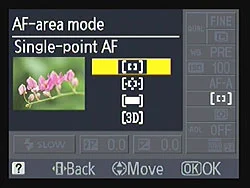
Autofocus is one of the great features available in modern DSLR camera. Some cameras are equipped with an Autofocus motor inside the camera and some are not. Similarly, there are lenses which come with the built-in Autofocus motor inside itself. Benefits of having an Autofocus motor inside the camera is that it can Autofocus the lens which doesn't have a built-in Autofocus motor. Nikon D40, D40X, D60, D3000 and D5000 models lack an Autofocus motor. But Nikon D90 does have an Autofocus motor built-in inside so that it can fully Autofocus the lenses which lack an Autofocus motor. There are two ways for the DSLR camera to focus the subject; manually and automatically. When your lens is setup to focus automatically (by using the switch available on the lens), camera offers few different ways to achieve that autofocus.

Different camera brands provide different kind of Autofocus mode and sometimes only the naming is different but the core functionalities are same. Most of the Nikon DSLRs including D90 come with the three different Autofocus modes and one Manual mode. To change between different Autofocus mode in D90, you have to press the AF button on the top of the camera near the monochrome LCD screen and rotate the main command dial. While changing the modes, you can see currently selected Autofocus mode on your top LCD screen as well. Most of the high end semi-pro or pro DSLRs come with the dedicated lever to switch/lever between different autofocus modes. Now, let's discuss about these different autofocus modes and when should we use them.

D700 Autofocus switch

D700 Autofocus switch

1. AF-S (Autofocus Single)

In this mode, focus is set once when you press the shutter release button halfway down and the camera keeps the focus locked on the subject until the shutter button is fully pressed to take a picture. If you release the shutter button without taking a picture, you will have to re-focus again to take the picture. This mode will be your best choice if you are shooting subjects that do not move such as landscapes, cityscapes or portraits etc. In this mode, by default, you might not be able to take a picture until the focus is locked on the subject.

2. AF-C (Autofocus Continuous)

This mode is good if you are shooting moving subjects like in wildlife and sports photography. When the camera is set to AF-C mode, once the shutter release button is pressed halfway down, the camera sets the focus on the subject but continues to monitor the subject in order to re-focus if it's moved from the original position. While shooting using AF-C mode, focus and exposure aren't really locked until you press shutter release button all the way down to take a picture. In this mode, by default, you can take a picture even if camera has not fully focused the subject but you end up getting blurry images.

3. AF-A (Autofocus Automatic)

This mode is actually a combination of the two modes described above. When your camera is set to AF-A mode, camera focuses subject using AF-S mode if the subject is not moving but it changes automatically to AF-C mode if subject starts moving. Isn't that pretty cool? This mode is pretty good when you are shooting mixture of the actions. This mode is probably the default mode in your camera. However, like in AF-S mode, subject needs to be sharply focused to release the shutter release button all the way down and then only camera takes the picture.

4. Manual Focus

You can use the manual focus mode when your lens is set to the manual focusing mode (using the switch on the lens itself) or if your lens is not equipped with an Autofocus motor. In this mode, you can manually focus your subject using the focusing ring on the lens barrel. Manual focus is popular among the landscape photographers specially when they want to achieve sharp focus from the foreground to the background (some prefer to focus into infinity and some prefers to focus into one third of the frame to achieve everything in focus).

Some photographers like to shoot in a manual focusing mode all the time but I prefer to use Autofocus mode most of the time except in some tricky landscape shot where I also use manual focus.