
As I have started using more and more, I feel like Nikon 18-200mm is one of the most fantastic kit lens Nikon ever made. This is standard telephoto zoom lens for Nikon DX-Format DSLR cameras. Photographers who used to carry lots of lenses for Wide angle, Portrait and Nature photography can now replace all their lenses with this versatile, very powerful and faster lens. This lens is reviewed over it's old version, 18-200mm VR lens, and hence it is named as 18-200mm VR II. It has a manual focus override, AF-S focusing motor, vibration reduction, takes 72mm filter and comes with HB-35 hood. This is almost same as old 18-200mm VR lens, with the addition of a zoom lock at focal length of 18mm. Lots of photographers complained about it's creeping problem when zooming in and out and Nikon tried to fix that problem with the lock feature at the beginning. But personally, I think that won't solve the problem if your lens starts creeping when you shoot facing your lens upward or downward and you are zooming around half the focal length, 140mm for example. This lock is good to prevent accidental creeping of your lens when you are walking and carrying it. I am using this lens since last 6 months and haven't had any creeping problem so far but cannot guarantee that it won't happen in near future. It might become a problem once I start using more and more, according to some photographers.
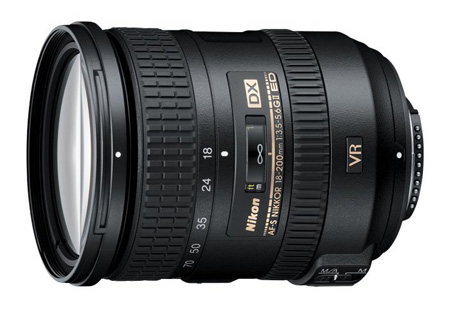
Nikon 18-200mm VR II Lens
Other than that, this lens is remarkably versatile with an 11x zoom factor, very sharp at all focal lengths and VR system is very helpful to stabilize the image. It is 100mm long when it is mounted at 18mm focal length and about 160mm long when it's fully extended. It is also useful to shoot closeup (like macro) shot. Maximum aperture of this lens is f/3.5-5.6 and minimum aperture is f/22-36 depending up on various focal length ranging from 18mm to 200mm. As I am using this lens more and more with my Nikon D90, I feel like this combination might feel heavier for long use (to carry around). But in overall, this is a fantastic lens.
If you already have an old version of this lens, I don't see a point why you want to spend around $800 to upgrade to this just to add a locking feature. But if you are looking to buy a good size lens that covers wide range of focal length so that you don't have to keep changing the lens, I think this lens could be the best option for you available in the current market. It is an amazing and most importantly all purpose lens in the current line up.
If you have this lens or planning to buy one, please share your experience with us. Happy Shooting!


If you have to carry only one lens, which lens would you choose? After purchasing a DSLR, it can be an overwhelming experience to select the right lens for the camera, specially if it is your first time purchase. There are so many camera brands to select from and they all have their own set of lenses. My first DSLR, Nikon D60, came with the kit lenses (18-55mm and 55-200mm) which removed my confusion on lens selection. Since then, I have owned two DX format DSLRs, two FX format DSLRs and various lenses from Nikon. Even though my first lenses were not my choice, it worked pretty well for me in all kinds of shooting scenarios. Later, when I upgraded my camera to D90, I bought it in a combo package which came with a 18-200mm lens along with other accessories including the memory card and the cleaning kit. Later, I sold all of my lenses and purchased a 18-300mm lens. All of these lenses are designed for different purposes and different shooting environments. Some of them are designed for all purpose shooting, some of them are for indoor shooting only and others are designed to reach long distance subjects. Some of the lenses are heavier and hard to carry around all day and some of them are light weight and made for traveling purposes. It’s hard to cover all of them in one blog post, but today, I am going to discuss one particular lens that might be an ideal for traveling purpose and specially if you want to carry only one lens that covers the variety of ranges.
When I purchased 18-300mm, I got AF-S DX Nikkor 18-300mm f/3.5-5.6 G ED VR lens which seems to be discontinued now and replaced by the newer model, AF-S DX Nikkor 18-300mm f/3.5-6.3 G ED VR, which I am going to discuss in today’s post. Let me briefly summarize the technical details and then we can go to the practical aspects of the lens.